British
Columbia is approximately 952,260 square km (367,660 square
mi.), this includes 18,000 square km (11,160 square mi.) of
inland water and is the third largest province in Canada. It
is made up of snow-covered mountains, rolling hills, alpine
meadows, plateaus, glacier fed lakes, swift flowing rivers,
lush forests, grasslands, and miles of rugged fiord coastline.
B.C. is ready made for exploring. The geography and adventures
are so diverse that few other places in North America can offer
the variety British Columbia can. It is an outdoor
recreational haven.
Camping in British Columbia is fast becoming the main outdoor
recreation of locals and tourists alike. Within the borders,
there are more than 400 different provincial parks for day use and
camping. Four of the six national
parks offer developed camping facilities. Hundreds of BC
Government recreation sites, located throughout the province,
offer rustic camping, boat launching and often maintained trails.
Each year, more people are enjoying the natural scenery, space
and more than 10,000 camping spots in B.C.
Camping means different things to different people. Some enjoy
camping in tents, others in recreational vehicles (commonly
known as RV's). Whether you enjoy camping with few facilities
or in your home-away-from-home RV, the beauty of the great outdoors
is waiting to be experienced. British Columbia was created for
camping and campers!
Park
Gates are closed from 11:00 pm to 7:00 am. No outside visitors
allowed after 11:00 p.m.
Always store food in the vehicles in airtight containers.
Light fires in the provided metal fire pits.
Camp only in the designated areas.
Use BC Parks garbage bins that they provide in the campsites.
Take only how much wood you will use.
Enjoy the flora and fauna in the parks. Look, smell and photograph,
but never pick or cut.
Remove all garbage and clean the campsite before leaving.
Do not use the fire pit as a garbage disposal.
Keep pets on a leash.
Check out time is midday. Maximum length of a stay is fourteen
days per year in anyone park. A party is considered a family from
the same address. No one under the age of sixteen is allowed a
campsite.
One camping vehicle per site, unless an additional vehicle is
being towed, or a member of the group is commuting to the park
in a different vehicle.
Never take powerboats near a swimming area.
Alcohol is allowed at your campsite, unless this privilege is
abused.
Facilities:
Most campgrounds in British Columbia have the basic facilities.
This includes water, wood, pit toilets, picnic tables and fire
pits. Some larger campgrounds can offer showers, flush toilets,
sani-stations, wheelchair access, group camping, visitor's centres
and interpretive programs. The camp spots are made tidy after
each visitor leaves, garbage is collected on a regular basis,
and washroom facilities are usually clean and well maintained. Fees:
At fee sites, fees are collected only from approx April to October.
Camping fees vary from site to site depending on the facilities.
Attendants, in most parks collect the cash only payment in the
early evening hours. Fees are resonable. There is a charge for
firewood in national parks. Whether camping or not, they charge
an additional fee in national parks.
For
current details and reservation information visit the following
websites:
British Columbia is blessed with an abundance of wildlife. Depending
on the season, you are apt to see cougars, bears, moose, deer,
sheep, goats, whales and many small animals. There are also hundreds
of different bird species that make their home
in B.C.
Bears are the most prevalent and dangerous of the wildlife in
the parks of British Columbia. BC has almost one-quarter of
all the black bears in Canada and close to half the grizzlies.
People and bear encounters are very rare, but always keep in
mind that you ARE in bear country. Be prepared and take the
necessary precautions. Never approach or feed a bear.
Necessary Camping
Items:
Some people take everything (including the kitchen sink) camping.
The RV campers, whether using a camper, fifth-wheel, or a motor
home have the opportunity to enjoy all the comforts of home.
These units have sleeping accommodations, stoves, fridges, furnaces
and everything a camper needs, and then some. Nevertheless,
whether you enjoy camping in a tent or a RV unit, certain items
can help make your experience fun. These items include aluminum
foil, an axe, a barbecue, camera and film, candles and/or a
lantern, a flashlight, a first aid kit that includes calamine
lotion and insect repellent. Make sure you have garbage bags,
matches and newspaper for the campfire, rope, sunglasses, hat
and sun screen, a tarp, towels, and rainy day activities.
The Recreation Sites & Trails BC offers a host of exceptional
recreation opportunities. While some of the Province's most
spectacular recreation features are located in parks, many more
recreation resources are found in the rugged and real backcountry.
Recreation sites and trails are public campgrounds and trails
located on Crown land outside of parks and settled areas.
The
backcountry provides an abundance of great places to have fun
and enjoy nature through activities such as camping, boating,
fishing, hunting, mountain climbing, hiking, kayaking, mountain
biking, ATVing, cross-country skiing, snowmobiling, and exploring.
So get to know BC's backcountry - it's the perfect place to
experience the wonders of the outdoors and create memories that
will last a lifetime.
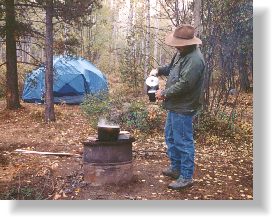
Camping
in a BCrecreation site is different from camping in one of BC's
Provincial Parks or in a National Park. These forest sites are
rustic and usually off the beaten track. They are enjoyed by
folks, who wish to get away from it all and enjoy outdoor activities.
Recreation
sites provide a simple, rustic camping experience. Generally
located in remote areas and accessed by gravel forestry roads,
recreation sites provide only basic facilities, such as fire
rings, picnic tables, outhouses, and, where appropriate, boat-launching
ramps. Sites are small and usually near a lake or river. The
recreational trails are designed for all types of usage from
hiking and horseback riding to skiing and snowmobiling.
Potable
water is not available, and there is no electricity at recreation
sites. At a limited number of recreation sites with on-site
operators, supervisory services are provided.
Some recreational sites have litter barrels supplied, while
other sites are "User Maintained" which means packing
out all your garbage. These sites are for everybody to use,
so please leave it clean. They do not provide firewood. Bring
your own or gather it. Burn only dead or downed trees, do not
cut trees. Most boat launches are for small car top boats. Persons
can launch trailered small and medium sized boats where there
are ramps.
Site
Locations & Information:
For
complete information and an interactive map of BC Recreation
Sites. Visit their Website: http://www.sitesandtrailsbc.ca
Etiquette:
There are some do's and don'ts when using recreational sites
and trails.
Try
not to damage any of the vegetation.
Respect fire closures.
Do not cut live trees or branches.
Build your camp fire in the fire ring and never leave a fire unattended.
Always use your ashtray when driving forest or wilderness roads.
Clean fish well away from your camp. Dispose of entrails in a
very hot fire or puncture the bladder and drop into deep or rushing
waters.
Never empty sewage from trailer or camper along the road or near
water. Use sani-stations.
Keep pets quiet and on a leash.
On leaving, make sure the site is clean and tidy.
Keep the noise level down and refrain from activities that may
annoy others.
If there are no litter barrels, take your garbage with you.
Never vandalize or destroy forest recreation sites and trails.
Rules and Regulations:
The following rules and regulations apply to all persons using
recreation sites and trails.
Never
use or discharge a firearm on or near the site.
Never use a vehicle or equipment that will interfere with other
people using or enjoying the site or trail.
You are allowed to stay or use the site or trail for only 14 consecutive
days, unless you have written permission
No person will continue to make noise or permit an animal to misbehave,
after being asked to stop.
Never put up a sign or structure on a recreation site or trail,
unless you have been authorized by a forest service officer to
do so.
Do not leave garbage on a site or trail.
Never leave fish or game offal, entrails, hides or bones on
a site or trail.
All pets must be on a leash and under the control.
Never endanger other persons, and do not damage property or the
appearance of a site or trail.
Humans cause approximately half of all forest fires, do your
share to help and prevent this needless damage to our forests
and environment. Use the provided fire rings, watch for flying
sparks and keep campfires as small as possible. Never leave
a campfire unattended and make sure the campfire is out before
you leave. Do not smoke while walking, butt out on a rock or
dirt. When driving use your ashtray. Always respect fire closures
and other forest restrictions.
Forest recreation sites and trails are off the beaten track,
so people can enjoy the wilderness. But this can bring people
into conflict with the wildlife, specially the black bear, the
grizzly bear and the cougar. Always practice wildlife safety.
Take necessary precautions and follow a few simple rules. Never
feed bears. Do not store food in your tent. Pitch your tent
away from where you cook and store your food. Never have your
tent near heavy brush, the lake shore, stream banks and animal
tracks. Keep your campsite clean and never bury garbage. Never
surprise bears. Do not hike alone, keep your distance when taking
photos and never come between a mother bear and her cubs. Keep
pets on a leash and leave the area if you spot any bear and
cougar tracks, droppings, or signs. Do not run from a bear,
instead back away slowly and try to stay calm.
The forest service build forest roads primarily for industrial
traffic, but the public uses them. These roads are classified
according to their surface and travel conditions. The paved
and gravel roads are good in all weather. The rough roads are
a gravel or dirt surface and passable with a two-wheel drive,
and the very rough roads are passable with a four-wheel drive.
Due to weather, usage and maintenance, road conditions can change
quickly, so be prepared. Roads can be closed during an extreme
fire hazard season and during industrial use. Not all forest
roads are maintained during the winter. If not familiar with
the area or the route, check with the nearest forest district
for road conditions.
Forest road travel is different from public highway travelling.
Not matter where you travel, always drive with extreme caution.
Before starting on a forest road, check your vehicle, fuel and
supplies. Always obey road signs, and give logging and industrial
traffic the right-of-way or pull off the road. Drive with your
lights on, especially on dusty roads. Always watch for animals,
rocks, downed trees and blind corners when on a forest road.
Stay in your vehicle if any wildlife is near. Always be very
careful if travelling or camping in forest recreation areas.



 Overview: