|
|
|
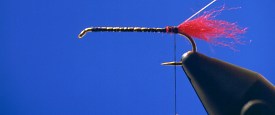
Step 1
:
Cover the hook shank with tying thread and secure the dubbing material to form the tail. The tail should extend to about half the hook shank in length. Attach the mylar rib.
|
When
one goes about developing a fly pattern there are often a number
of characteristics worth imitating. It might be a specific size
or color. Perhaps the materials mimic the movement of the natural.
Better yet maybe you are aiming at a specific stage in an insect's
life. You might spend time reading up on other patterns or habits
of the insect or organism. Maybe you have spent lots of time using
your powers of observation. Whatever the reason the development
of a pattern is usually a product of painstaking research and experimentation.
|
|
|
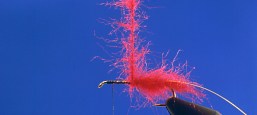
Step 2
:
Use a dubbing loop and dub a robust body.
|
When
I approached angling friend Bill Lee regarding his Big Red I was
expecting similar research as to other fly pattern designs. Bill
began the history of the Big Red by telling me that roughly 10 to
12 years ago his wife had purchased some wool. Bill found its qualities
interesting and began to think about its use in some future fly
pattern. A couple of days later Bill had a dream about a fly. That's
right a dream! As a result of that dream the Big Red was born. So
much for detailed research and painstaking experimentation, I have
been going about creating fly patterns all wrong. Bill has the ultimate
system. Following his dream Bill tied up the original prototype
of the Big Red. He took his new pattern out to a local slough one
morning and promptly caught 5 Coho!
|
|
|
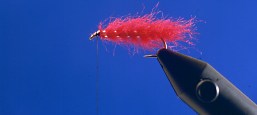
Step 3 :
Wind the rib forward with 5 to 6 open turns depending upon
the size of the fly. Take a Velcro comb and brush all sides
of the fly to create a bushy effect.
|
Since
its inception Bill has made a number of variations both in wing
material and body design on his Big Red. I remember being shown
how to wind the wool on but to roughen it in mohair like fashion.
In this mohair condition Bill formed the body like a conventional
mohair leech. Now Bill uses a coffee grinder to blend the wool into
dubbing. The resulting dubbing mix creates a shaggy body especially
after being brushed with a Velcro comb. The original body material
was a Baycrest yarn known as Courtney. It came in a wide range of
colors. Courtney is a fuzzy yarn composed of 70% acrylic and 30%
nylon. Unfortunately this yarn is no longer available although some
of the Bay stores may have a limited supply but I wouldn't count
on it. I would look for a similar brand with the same qualities
in a scarlet red coloration. Bill has also tied this pattern in
orange and pink with good results. The wing was originally white
Polar Bear hair. Bill now uses Arctic Fox. Bill expressed some concerns
over the white color of the material but the movement it provides
has been very successful.
|
|
|
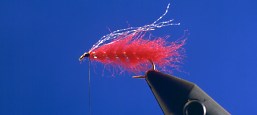
Step 4 :
Attach 4 to 6 strands of crystal hair. Keep it sparse it is
easy to get carried away and over dress the pattern.
|
Put
it this way the Coho and Cutthroat Bill has duped with this pattern
don't mind the fox wing at all. As for hook size Bill ties the Big
Red in sizes 4 through 8 on Mustad 9672 or Tiemco 5263. If Bill
had to choose one size it would be a #6.
This
pattern fishes well in the slow even flows characteristic of the
rivers and sloughs throughout the Fraser Valley. Popular tackle
includes an 8 weight system, (Chum Salmon like this pattern also)
coupled with a Mono-Core or Stillwater fly line and a 9-12 foot
leader. The Stillwater line is a newer design that behaves better
in the cooler weather of the season. Originally designed for tropical
use, Mono-Core suffers from memory problems in cold weather. An
energetic Chum salmon is a great way to stretch the line and eliminate
this memory problem. Common presentation usually includes a reach
cast, possibly a mend and then a steady 6-12 inch strip retrieve
much like you were shaking a thermometer. Bill is also a fan of
fishing this pattern on a long leader and a dry line.
|
|
|
Step 5 :
Select a clump of Arctic Fox fur for the wing. Keep things
sparse so you don't defeat the motion of the fox fur. The
tips of the fox fur should reach the tip of the tail.
|
For
this method Bill weights his Big Red with a dozen wraps of .010"
or .015" lead wire substitute. The Big Red is also a great pattern
for Cutthroat. Bill has even used this pattern successfully on some
of our coastal lakes. I am even thinking of putting a few of these
in my lake fly box for those slow days. Many Kamloops area fly fishers
have a red pattern of some description in their fly box to shake
up inactive fish. So next time you have a strange dream regarding
a fly pattern, act on it. Who knows it could be a real winner.
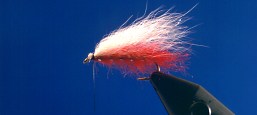
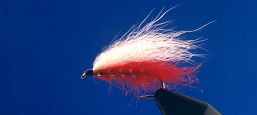
Bill's
Big Red
-
Hook: Tiemco 5263 or Mustad 9672 #4-#8
-
Thread: Black 6/0 or Red 6/0 if weighted
-
Tail: Scarlet Red Dubbing Material
-
Rib: 5 to 6 wraps of #16 or #18 Silver Mylar
-
Body: Scarlet Red Dubbing Material ` (Orange and Hot Pink Variations
Also Work Well)
-
Underwing: 2 to 4 Strands of Crystal Hair Overwing: Arctic Fox
Fur
|
 |
|
Step 6 :
Whip finish and apply head cement. Have a good night's sleep,
sweet dreams and go fishing.
|
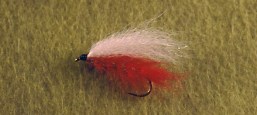
The final product.
|

|